
The article explains the rise of LLM tracking as a separate discipline from classic SEO and compares four vendors through practical buying criteria such as model coverage, actionability, pricing model, and the ability to turn tracking into AEO execution. Rather than simply naming winners, it positions each tool around different team shapes: Semrush for integrated SEO plus AEO, Peec for startups and agencies, Gumshoe for persona-led research, and Otterly for lean teams needing affordable monitoring. While the article clearly markets eesel's own content tooling around the review, the product being promoted is not one of the ranked LLM trackers, so the comparison still works as an outside market overview. The piece is most useful as a narrative on what teams should optimize for when choosing between full-suite platforms, specialized trackers, and strategy-first tools.
Published Reviews
Editorial reviews and scorecards of AI search visibility tools.


The reviewer says Get Mentioned covers the basics well: tracking visibility across major AI engines, comparing against competitors, and surfacing commonly cited sources that can inspire content ideas. They also call out unlimited competitor tracking and the use of real web interfaces instead of only API-based collection as meaningful advantages. At the same time, the product is framed as early and somewhat lightweight. The reviewer says it is better for companies that want a simple interface and foundational metrics than for those needing richer analytics, sentiment tracking, or AI traffic measurement.
Pros Mentioned
Cons Mentioned

The reviewer positions Gumshoe as one of the most complete tools in the category, emphasizing persona-level prompt analytics, strong documentation, fast setup, broad AI engine coverage, and a data collection approach that combines APIs with real web interfaces. They also praise the added GEO audit and content generation features, which make the platform feel broader than a simple monitoring dashboard. The tradeoffs are that Gumshoe still lacks AI traffic analytics and sentiment tracking, and some generated outputs need editing before use. Pricing is described as flexible rather than cheap, but the reviewer still sees it as fair for the functionality, especially for teams that want deeper monitoring across many engines.
Pros Mentioned
Cons Mentioned
The reviewer says Otterly is a dependable mid-tier AI search visibility tool that does what it promises and is helped by a friendly onboarding experience. Its standout differentiator is the GEO audit, which checks AI-readiness factors and page-level issues in a way the reviewer says many competitors either lack entirely or reserve for much higher-priced plans. The main caveat is that Otterly does not provide AI traffic analytics, which the reviewer clearly wanted. Pricing is considered average at the core tiers, but add-ons can push costs much higher for teams that need broader engine coverage or heavier usage.
Pros Mentioned
Cons Mentioned
The reviewer finds Peec AI useful for teams that want a clean interface, straightforward setup, competitor and source tracking, and lightweight sentiment reporting without paying enterprise-style prices. They also say the data is good enough to support business decisions, even if it remains third-party visibility data rather than something fully definitive. The downsides are mostly around actionability and depth: Peec does not yet turn its data into concrete recommendations, and it lacks AI traffic analytics and ROI-style reporting. The overall verdict is still favorable, especially for agencies or teams that need presentable monthly reporting and a simple workflow.
Pros Mentioned
Cons Mentioned
The reviewer presents Scalenut as a strong budget-conscious option, highlighting simple onboarding, solid data accuracy, and pricing that came in lower than other tools they tested for a similar prompt-and-engine mix. They also note that the platform uses real AI search engine interfaces and includes Reddit sentiment tracking, which adds practical value for smaller teams. The main concern is scale. Pricing rises with tracked prompts and engines, so larger enterprises may see costs grow quickly, and sentiment tracking appears narrower than all-web alternatives. Even so, the reviewer's recommendation is clearly positive for smaller teams that mainly need AI visibility coverage.
Pros Mentioned
Cons Mentioned

The reviewer presents Scrunch as one of the stronger AI search visibility platforms currently available, based on testing across multiple SaaS and B2B consulting cases. They highlight its modern, easy-to-configure interface, reliable-enough analytics, influence and source discovery views, and early content optimization support. The main limitation is depth: the reviewer wanted better drill-down on brand mentions and more clarity on how competitive prompts surface specific brands. Even with that gap, the overall verdict is clearly favorable, with Scrunch described as a top-three option in the category.
Pros Mentioned
Cons Mentioned
The reviewer says SEMrush does offer real value for AI visibility work, including quick top-line visibility reporting, geo support, prompt visibility views, sentiment-style brand comparisons, and the benefit of sitting inside a broader SEO platform. For teams already invested in SEMrush, that integration is a meaningful advantage. The criticism is that the product feels undercooked: topic clustering and automated prompt suggestions can be overly broad or irrelevant, the interface behaves in unexpected ways, and some outputs appear better suited to B2C than B2B or SaaS use cases. Pricing also becomes a major drawback once agencies add users, properties, or more prompts.
Pros Mentioned
Cons Mentioned
The reviewer says WriteSonic provides the core AI visibility data they need and goes further with content strategy, site audit functionality, and Chatsonic support. AI engine coverage is described as good enough, and pricing is viewed as acceptable for mid-market buyers relative to some larger competitors. The review becomes more cautious around packaging and value. Sentiment analysis and some GEO-oriented help are locked behind higher tiers, integrations are limited, and the tool is not positioned as a good choice for budget-sensitive companies. Overall, though, the verdict remains positive for medium to larger businesses that want both monitoring and some strategic assistance.
Pros Mentioned
Cons Mentioned

Graphite frames the AEO market as a fast-growing but still immature category where the most dependable product value is AI answer tracking, citation monitoring, and basic brand visibility analysis. Its guidance is intentionally pragmatic: buy the lowest-cost tool that covers the tracking work you actually need, and be cautious about paying a premium for optimization promises before the category matures further. The article functions as a market map rather than a winner-take-all ranking. It spans specialist GEO vendors, SEO-suite extensions, PR-led AI visibility products, local SEO tools, and technical QA-style monitoring platforms. Because Graphite is not one of the tools in the roundup, this is best treated as a third-party listicle/article rather than a host-self product review.



Loopex Digital frames AI search visibility tooling as essential infrastructure for brands that want to monitor how often they appear in AI-generated answers, measure sentiment, and understand citation patterns across platforms like ChatGPT, Google AI Overviews, Perplexity, and Claude. The article blends market education with a broad buyer's guide, comparing tools by platform coverage, prompt scale, reporting depth, and fit for different types of marketing teams. The roundup is more buyer-oriented than deeply methodological, but it still surfaces meaningful category distinctions. Profound is positioned as the enterprise leader, SE Ranking as the strongest SEO-specialist option, Otterly as the value choice, seoClarity and Semrush as strong suite players, and vendors like Nightwatch, Goodie AI, Bluefish AI, Trackerly, and AthenaHQ as differentiated picks for specific workflows or market segments.


Overthink Group evaluates seven major AI visibility tools against a detailed methodology built around a hypothetical B2B SaaS client project. Instead of relying on marketing copy, the article scores tools on segmentation architecture, parameter control, competitor comparison, sentiment analysis, and how much manual reporting work they save real strategists. The piece is notably skeptical about the category as a whole. It argues that the top tools are useful for approximating AI visibility and cutting down manual work, but still require careful prompt design, thoughtful reporting, and human interpretation. Profound leads as the most well-rounded option, Scrunch stands out on segmentation, Peec wins on affordability, Rankscale excels at sentiment analysis, and Ahrefs Brand Radar lands last because its methodology is hard to operationalize for many teams.
Pros Mentioned
Cons Mentioned
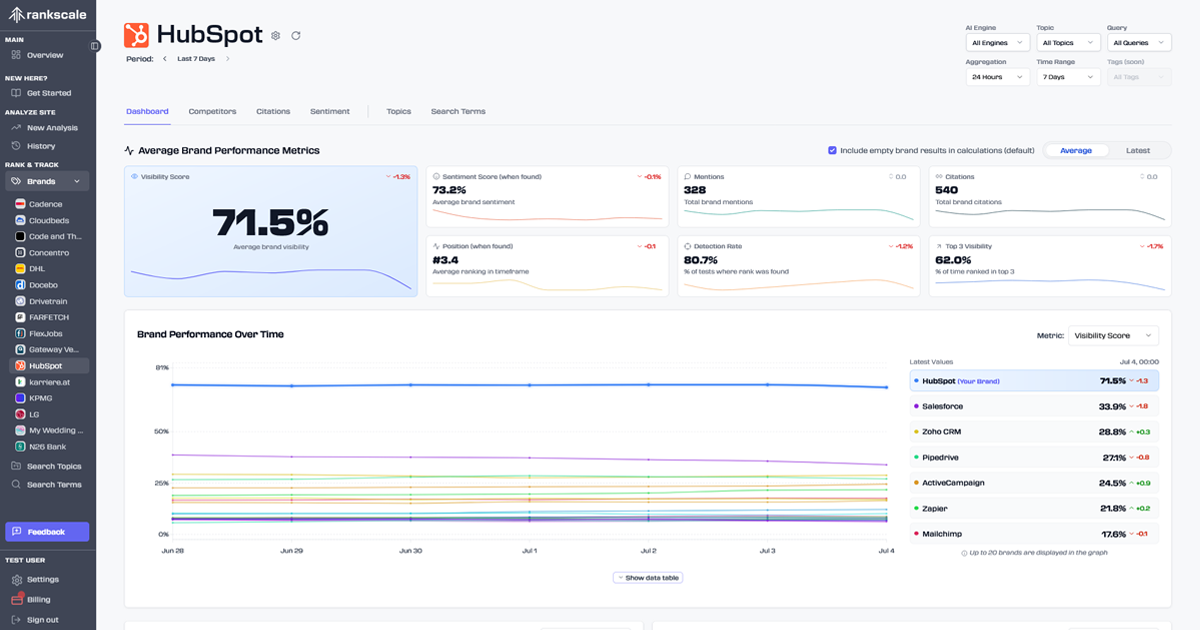
The article surveys a crowded 2026 market of AI visibility and LLM tracking platforms, arguing that traditional SEO tooling no longer captures how brands appear in ChatGPT, Gemini, Perplexity, and other answer engines. Instead of applying a numeric rubric, SaaStorm frames the piece around practical buying criteria such as multi-platform coverage, data quality, multi-domain management, fair pricing, and whether a platform provides actionable optimization help beyond raw tracking. The review blends firsthand evaluation notes with community commentary from founders and marketers, resulting in a qualitative landscape view rather than a ranked scorecard. It highlights strengths, tradeoffs, and positioning for tools ranging from focused startups like Peec and Trakkr to enterprise-oriented platforms like Profound and AthenaHQ, and it closes with the view that most teams should test several options before choosing the right fit.
Pros Mentioned
Cons Mentioned

This article compares 15 AI search visibility and AEO platforms against the same 48-point rubric, scoring each tool across visibility tracking, answer monitoring, prompt analysis, citation coverage, optimization workflows, technical diagnostics, integrations, and pricing fit. Rather than relying on vendor marketing alone, it highlights where each platform is strongest, what tradeoffs buyers should watch for, and which tools are best suited for solo consultants, agencies, in-house teams, e-commerce brands, or enterprise programs. Beyond the raw scores, the review gives practical guidance on how these products differ in day-to-day use - from crawler log analysis and ChatGPT Shopping tracking to content optimization, localization, and AI accessibility auditing. The result is a buyer-oriented summary that helps readers narrow the field based on use case, team size, workflow depth, and budget tolerance.
Pros Mentioned
Cons Mentioned


WordStream argues that AI answer engines are becoming a meaningful discovery channel long before prospects ever click through to a website, so brands need dedicated monitoring for mentions, citations, and narrative accuracy. Rather than scoring vendors numerically, the piece explains what each platform is best at, where it falls short, and how teams should think about integrating AI visibility data into SEO, PR, support, and product workflows. The article favors tools that surface real prompt-response context or actionable monitoring rather than vanity dashboards. It highlights Ahrefs as an SEO-adjacent option, Peec and Profound as more direct AI visibility platforms, Keyword.com as a bridge from rank tracking to AI monitoring, XFunnel as a cross-channel analytics layer, and First Answer as an accuracy-first monitoring product.
Pros Mentioned
Cons Mentioned

Zapier reviews more than surface-level product claims and evaluates each tool on model coverage, recommendation quality, trend analysis, citation detection, sentiment, competitor benchmarking, and technical AI-readiness signals. The article makes clear that the category is still immature, but it identifies which tools are best suited for enterprise monitoring, budget-conscious teams, deep reporting, SEO-adjacent workflows, and content execution. The roundup favors products that do more than show mention counts. It calls out Profound for breadth, Otterly for affordability, Peec for smart suggestions, ZipTie for detailed reporting, and established SEO vendors like Semrush and Ahrefs for teams already invested in those ecosystems. It also notes that tool choice depends heavily on whether a team needs monitoring only, execution help, or a bridge from traditional SEO into GEO.
